
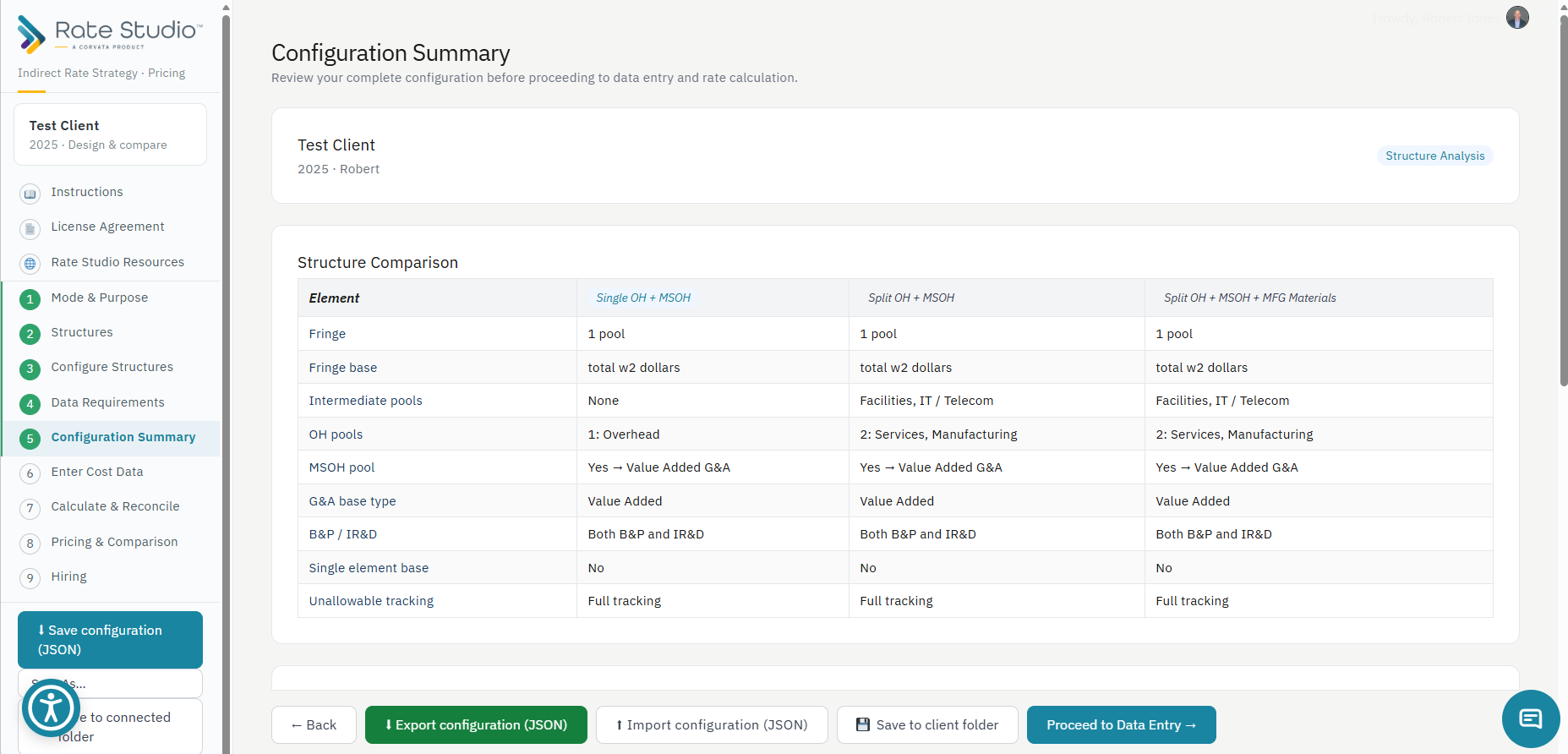
A single indirect rate structure – one Fringe, one Overhead, one G&A – is the simplest way to run your books. It’s also the default most small government contractors start with, and for a young or homogeneous business, it’s often the right call. But as a company adds service lines, opens a second location, or starts mixing manufacturing and engineering work under one roof, that same indirect rate structure starts doing something quietly expensive: it overprices some of your work and underprices the rest.
A Real Example of What Blending Costs You
Consider a contractor with several distinct lines of business, all running through one overhead pool. On paper, the blended overhead rate came out to over 90%. That number alone should raise an eyebrow, because a rate that high, applied uniformly, usually means very different types of work are being forced into the same bucket.
When we broke apart that overhead pool and rebuilt it around the actual cost drivers, separating the business segments that were genuinely different from one another, the picture changed substantially. Some segments settled into single-digit overhead rates. Others, once properly isolated, were considerably higher than the original blended number. The exercise also produced a new intermediate facilities pool and a material handling pool.
Nothing about the underlying costs changed. What changed was visibility. Under the single rate, the business’s most efficient work had been quietly subsidizing its most overhead-intensive work, and nobody could see it happening.
The Underlying Problem: Losing the Causal-Beneficial Relationship
Cost Accounting Standards 418 requires a logical connection between the costs in a pool (the numerator) and the work that benefits from them (the denominator). When you blend dissimilar types of costs into one pool and spread them over one base, you can still pass an audit, since the math still divides cleanly, but you’ve broken the logic that indirect rates are supposed to represent. You’re no longer answering “what does it actually cost to deliver this work,” you’re answering “what does it cost on average across everything we do,” which is a very different question when your business isn’t actually average across everything.
This is why blended rates tend to produce two bad outcomes at once: you lose competitiveness on your leanest work because it’s carrying costs that don’t belong to it, and you lose margin on your overhead-heavy work because the rate charged to it doesn’t reflect its true cost. Business owners often sense the first problem, “we keep losing bids we should win,” without ever connecting it to the second. DCAA auditors, for their part, are trained to look for exactly this kind of distortion.
Signs You’ve Outgrown a Single Indirect Rate Structure
An indirect rate structure needs to match your actual business operations, not just be administratively convenient. Ask yourself:
- Have you added a new product line, service line, or operating location since you set your current rate structure?
- Do you have work that’s genuinely different in nature, manufacturing versus services, client-site versus contractor-site, union versus non-union labor?
- Does a division manager or program manager routinely push back that they’re “carrying” costs that don’t belong to their work?
- Is your rate structure and proposal process starting to feel disconnected from how the business actually runs day to day?
If you answered yes to more than one of these, it’s worth modeling what a split structure would actually do to your numbers before you commit to changing anything.
You Don’t Have to Guess
Splitting cost pools isn’t something to do lightly, and it isn’t reversible without real administrative cost, including new GL structure, new policies, and new training. The right first step is never “let’s just split it and see.” It’s modeling the alternative indirect rate structures against your real historical data, so you know what you’re walking into before you touch your chart of accounts.
That’s the exact problem Rate Studio’s Multi-Model edition is built to solve. Instead of building parallel spreadsheets by hand to test a split fringe, a split overhead, or an added material handling pool, you can build and compare multiple complete rate structures side by side, using your actual numbers, and see the real impact before you commit to anything operationally.
In the next few posts in this series, we’ll walk through the three most common ways contractors build advanced rate structures, splitting Fringe, splitting Overhead, and adding a Material & Subcontract Handling pool, and what to watch for in each.
Rate Studio is a purpose-built tool for modeling and managing indirect rates.
This post is part of the Beyond the Single Rate series. To learn more, schedule a conversation.