
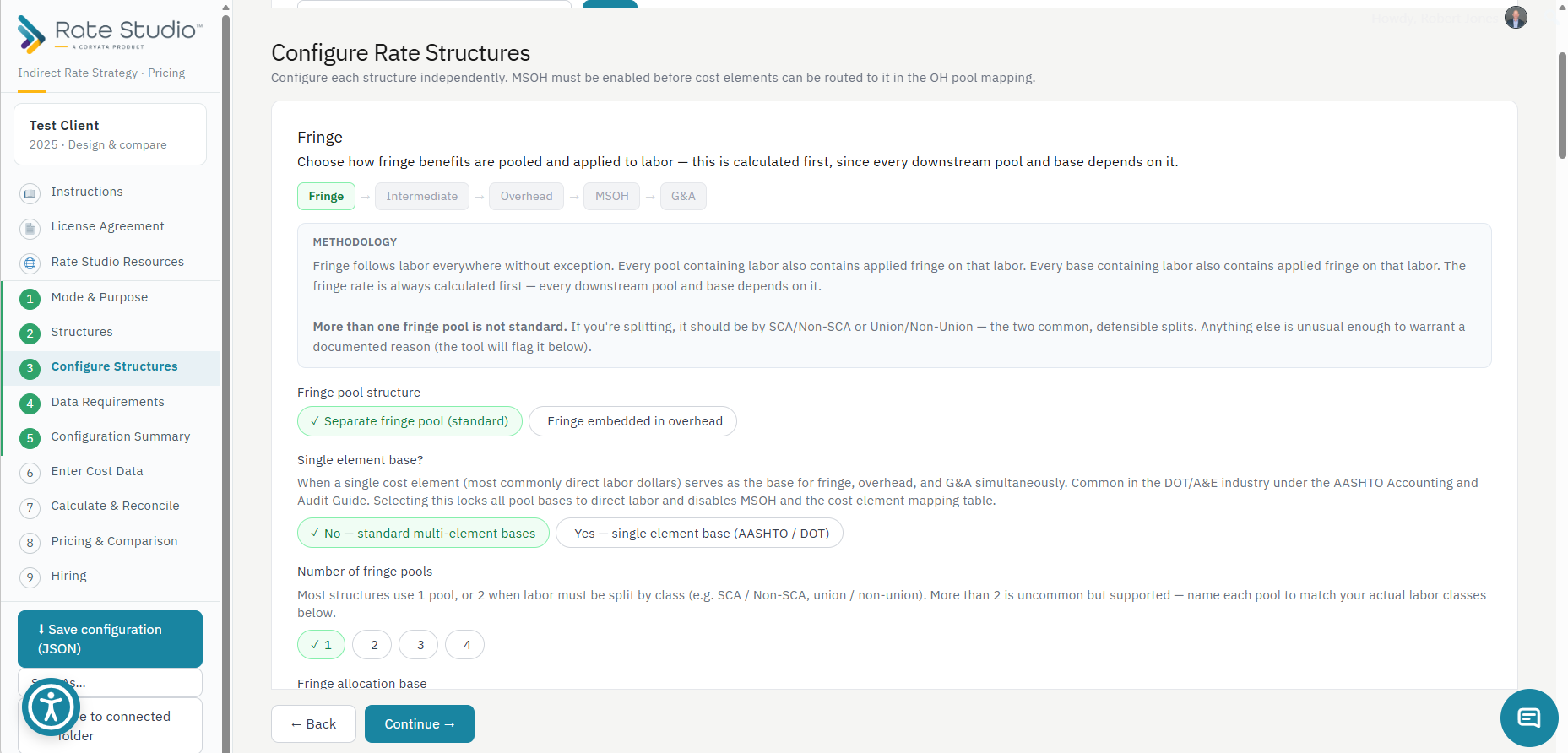
Splitting fringe into more than one pool is one of the first structural changes GovCon contractors consider, and one of the easiest to get wrong. Fringe is usually the easiest indirect rate to explain, and the first one people assume they understand: employer taxes, health insurance, retirement, and paid absences- costs to maintain your W-2 employees, allocated over W-2 labor. Simple, until your workforce isn’t uniform anymore.
The Rule That Doesn’t Change
Fringe follows labor everywhere. That follows from the logic of the pool rather than preference: you incur fringe costs because you have W-2 employees, so the base has to be every dollar (or hour) of W-2 labor that benefits from those costs, not just the direct portion. This holds true whether you have one fringe pool or five. Splitting fringe doesn’t change that principle; it changes how many groups of employees you’re applying it to.
When Splitting Fringe Actually Makes Sense
Splitting fringe only holds up when you have legally distinct groups of employees with materially different, formally documented benefit packages. The two situations that come up most often:
SCA vs. non-SCA. Service Contract Act wage determinations mandate minimum fringe benefit levels that are frequently richer than what a contractor provides its commercial or non-SCA government workforce. Blending SCA and non-SCA employees into a single fringe pool means one group is subsidizing the other’s rate, and neither number reflects reality.
Union vs. non-union. Collective bargaining agreements often define benefit levels that differ meaningfully from what’s offered elsewhere in the company. If those packages are genuinely different and formally documented, a split pool gives you a rate that actually reflects each group’s cost structure.
Both of these share a common thread: the groups are legally defined, the benefit differences are substantial, and the split is defensible under Cost Accounting Standard 402 because there’s a real distinction on paper, not just a preference.
Where Splitting Backfires
Not every workforce difference justifies splitting fringe into a second pool. Splitting on part-time versus full-time status is the example that trips people up most often. It sounds reasonable on the surface, but in practice the rate difference is often too small to justify the added complexity, and the effort of maintaining two pools, two allocation bases, and two sets of reporting outweighs the benefit. Worse, if employees move between part-time and full-time status, or between contracts that use different labor pools, you may need to reclassify people mid-year, which is its own administrative headache.
The test isn’t “can I draw a line between these two groups of employees?” It’s “is the benefit difference large enough, and the groups stable enough, that maintaining a second pool is worth the ongoing cost of doing so.” If you’re not confident the answer is yes, it probably isn’t.
The Part People Skip: Splitting the Base, Not Just the Pool
If you split a fringe pool, the base has to split with it. SCA fringe costs get allocated over SCA labor dollars only, not over your entire W-2 payroll. This sounds obvious written down, but it’s the single most common mistake we see when people reorganize a cost pool. Split the pool without splitting the base and you end up under-allocating costs, which means you’re not recovering everything you’re actually spending. The pool and the base move together or the math breaks.
Model It Before You Commit
Splitting fringe means new general ledger structure, new timekeeping and payroll coding, and new policies and procedures. This isn’t a change to make on a hunch. Before touching your chart of accounts, it’s worth knowing what the resulting rates would actually look like using your real numbers.
That’s the exercise Rate Studio’s Multi-Model mode is built for: stand up a second fringe pool against your existing data, see both resulting rates side by side, and confirm the split is worth the operational lift before you commit to restructuring your books.
Rate Studio is a purpose-built tool for modeling and managing indirect rates.
This post is part of the Beyond the Single Rate series. To learn more, schedule a conversation.