
Splitting overhead is one of the most common structural changes contractors consider when operations get complex enough that a single rate no longer makes sense. Overhead covers more ground than any other indirect pool: facilities, equipment, supervisory labor, supplies, training. That range is exactly what makes a single overhead rate risky once a business has more than one kind of operation running under it.
The Requirement Behind the Decision
Cost Accounting Standard 418 requires a logical causal-beneficial relationship between the costs in an indirect pool and the work that benefits from them. In practice, that means two things: the pool must be homogeneous, containing only one kind of cost, and the base must reflect what actually drives those costs. A single overhead pool holding both manufacturing floor costs and engineering office costs, allocated over a single direct labor base, satisfies the math but not the standard. The two kinds of work do not share the same cost drivers, so blending them into one rate breaks the relationship the standard requires.
Four Situations Where Splitting Overhead Holds Up
Not every operational difference justifies a second overhead pool. The split has to track a real, sustained difference in the cost of doing the work, not a preference for how the org chart is drawn. Four scenarios come up most often in practice.
Separate Office Locations
The cost of running an office in San Diego is not the cost of running one in Dayton. Rent, utilities, and labor rates vary by geography, and an employee doing identical work in a higher-cost location genuinely costs more to support. When two locations differ enough on these drivers, allocating both through a blended overhead rate means one location subsidizes the other.
Client Site vs. Contractor Site
An employee based at a government site is cheaper to support than one based at your own facility, because the government is already paying for the rent, utilities, and maintenance that your overhead pool would otherwise cover. Charging a full contractor-site overhead rate to client-site labor overstates the true cost of that work, and government customers notice.
Manufacturing vs. Engineering
Manufacturing overhead and engineering overhead are rarely close in scale. Machinery, production floor space, and equipment maintenance drive manufacturing costs in ways laptops and cubicles never will for an engineering group. Blending the two produces a rate that overstates the cost of engineering work and understates the cost of manufacturing work, which is precisely the distortion that shows up as lost competitiveness on your service proposals.
Separate Product or Service Lines
Some products or services require specialized equipment, testing, or handling that others do not. Spreading those costs across every product line means some products carry overhead that has nothing to do with how they are actually produced, while the products actually driving that cost look artificially cheap.
The Mistake That Erases the Benefit
Splitting overhead only works if the base splits with the pool it came from. This is the single most common error we see when a contractor reorganizes overhead: they create separate manufacturing and engineering pools, then continue allocating both over the same combined direct labor base instead of splitting the base to match. The result looks like progress on an org chart but produces two pools chasing one number, and the business ends up under-recovering its actual costs, exactly the kind of variance DCAA auditors flag during a review of incurred costs.
The numbers make the stakes concrete. Under a single blended overhead pool, an employee earning $30.00 per hour might carry $18.00 of overhead, putting their all-in cost before fringe, G&A, and fee at $48.00 per hour. Once the pool and base are split correctly to match the actual cost structure, that same employee’s all-in cost could land at $57.50 per hour in one pool or $39.60 per hour in another, depending on which segment of the business they support. One rate goes up. One goes down. That is simple math, not a flaw in the exercise, and it is exactly why testing the split before committing to it matters.
Model It Before You Restructure
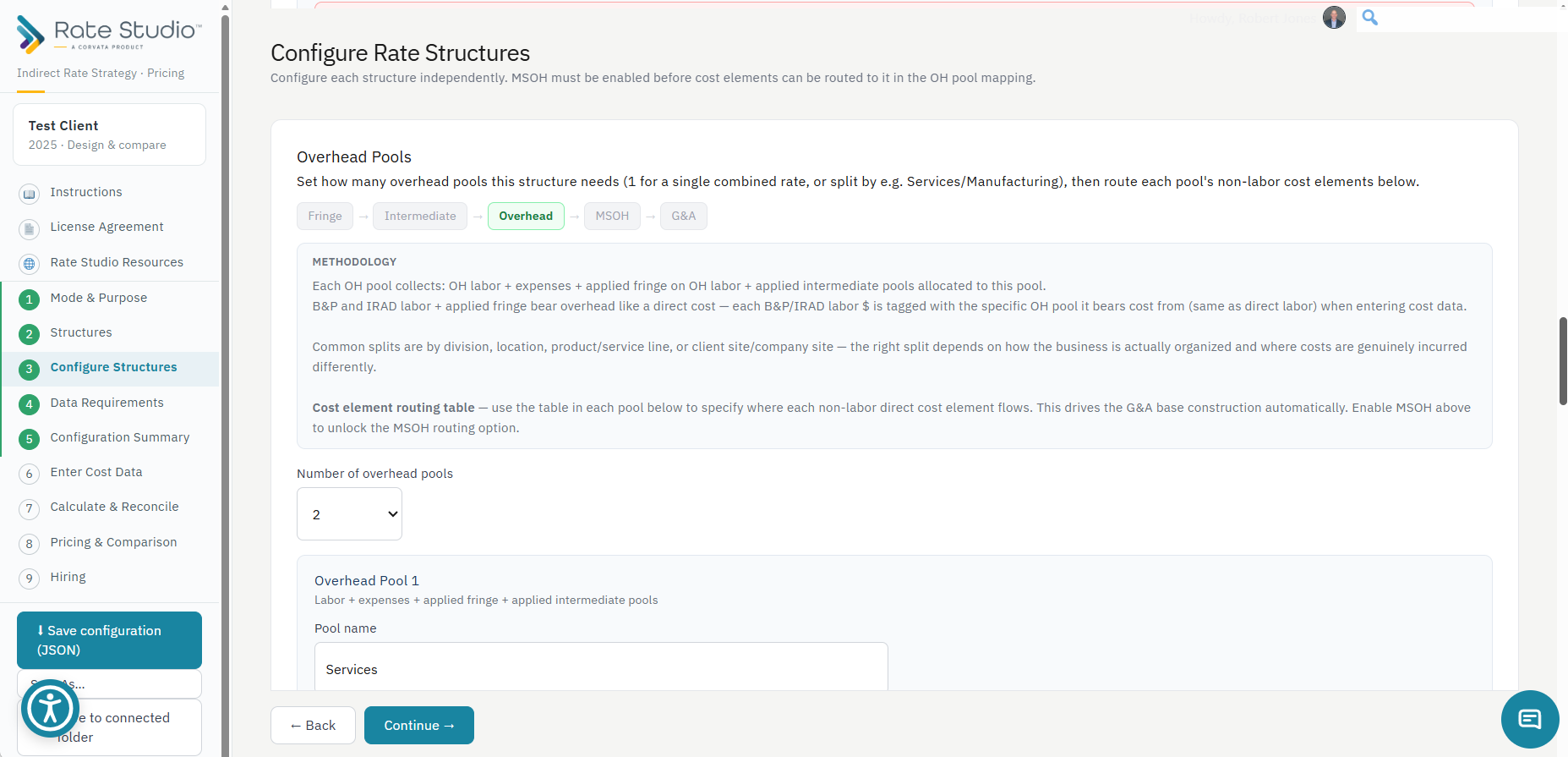
Splitting overhead means new general ledger accounts, new department or project coding, and a base you have to rebuild to match the new pool structure. None of that is worth doing on instinct. Rate Studio’s Multi-Model mode lets you build a manufacturing pool, an engineering pool, or a site-based split against your actual historical data, and compare the resulting rates side by side before you touch your chart of accounts.
Rate Studio is a purpose-built tool for modeling and managing indirect rates.
This post is part of the Beyond the Single Rate series. To learn more, schedule a conversation.