
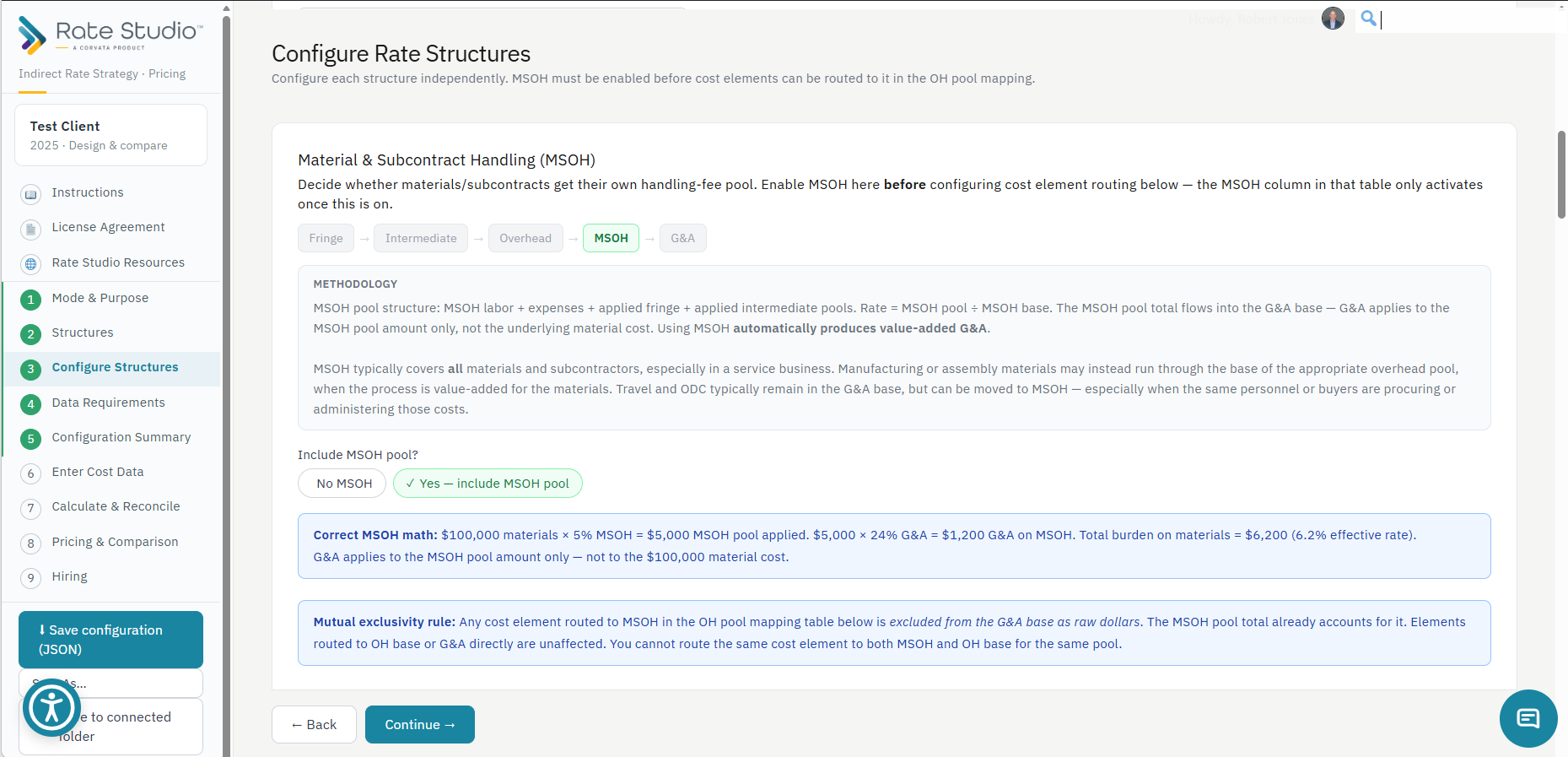
An MSOH pool is often the fix when a G&A rate above roughly 25% draws the same reaction from customers and auditors alike: a request to justify what that “management and administration fee” is actually buying. Sometimes the answer is genuinely high G&A costs. Often the real answer is a materials and subcontracts problem an MSOH pool is built to solve.
Why Materials and Subcontracts Inflate G&A
Under a standard total cost input base, G&A is allocated over every other cost in the business, direct labor, material, travel, subcontracts, and the indirect costs applied to them. That works fine when materials and subcontracts are a modest slice of your direct costs. It breaks down when a contractor passes through a large volume of materials or subcontracted effort on behalf of the government, because that pass-through volume gets burdened with the same G&A rate as your labor-driven work, even though administering a purchase order takes a fraction of the effort that managing a labor-intensive project does. The result is a G&A rate that looks disproportionate to the actual management effort involved, and a customer who has every right to ask why, as outlined in I can lo.
What an MSOH Pool Actually Does
A Material and Subcontract Handling pool separates the true cost of administering materials and subcontracts, buyers, subcontract administrators, supplies, and the applied fringe, facilities, and IT costs that support them, into its own pool, allocated only over direct materials and subcontracts. Because that administrative cost is usually small relative to the dollar volume of materials and subcontracts it supports, the resulting rate is typically much lower than their G&A. Many contractors target and achieve something under 10%. This also shifts G&A from a total-cost input base to a value-added base, since materials and subcontracts move out of the G&A base once the MSOH pool handles them.
The Step Contractors Miss
Creating an MSOH pool does not remove materials and subcontracts from needing to absorb their share of G&A, a requirement rooted in the same Cost Accounting Standard 418 causal-beneficial logic that governs every indirect pool. It changes how that happens. The MSOH-burdened cost still flows into the G&A base, and G&A still applies on top of it. Skipping that second step is the single most common mistake we see once a contractor builds an MSOH pool, and it directly costs money.
Here is what the full cascade looks like on $100,000 of direct material, with a 5% MSOH rate and a 24% G&A rate: $100,000 x 1.05 x 1.24 = $106,200. Notice that the rates compound in sequence rather than simply adding together. A contractor who mistakenly treats this as 5% plus 24%, or 29% applied once, would land at $129,000 of burden on the same $100,000, wildly overstating cost in one direction, or worse, stop at the MSOH-burdened figure of $105,000 and never apply G&A at all, quietly under-recovering costs in the other direction. Neither shortcut gets you to the correct number. Apply the rates in sequence, each to the result of the one before it.
Model the Cascade Before You Rely On It
This is the calculation most likely to go wrong in a manual spreadsheet, because the compounding order is easy to build correctly once and then break the next time a formula gets copied or a rate changes. Rate Studio’s calculation engine runs the full Fringe-through-G&A cascade automatically, including the MSOH pool, so the compounding happens the same way every time and you can see exactly how a change in the MSOH rate moves the final number a contractor actually bills.
Rate Studio is a purpose-built tool for modeling and managing indirect rates.
This post is part of the Beyond the Single Rate series. To learn more, schedule a conversation.