
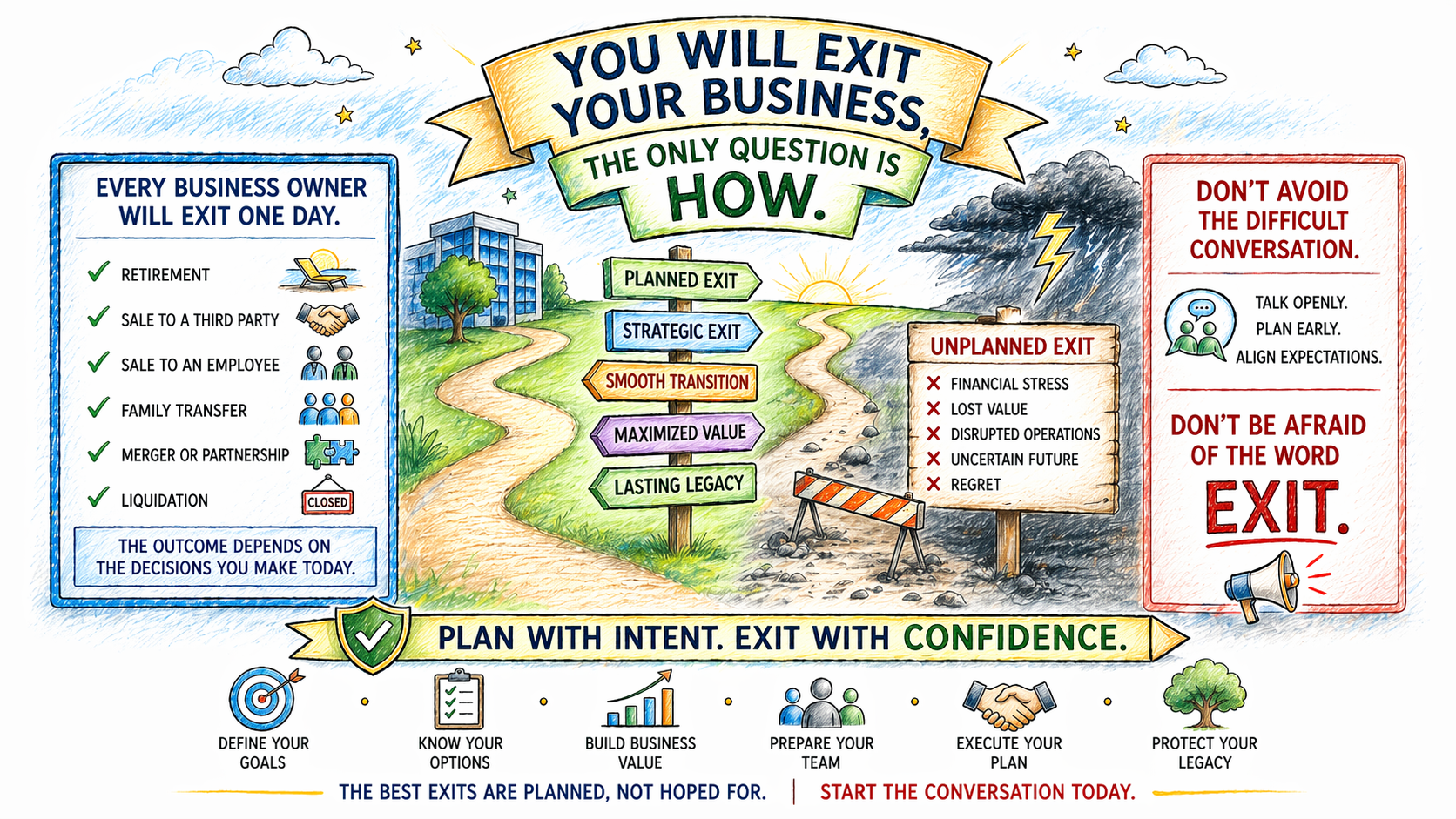
The Conversation No One Wants to Have
Most government contracting owners will discuss almost any aspect of their business openly. Revenue growth. Contract pipeline. Talent challenges. Compliance burdens. The strategic outlook for their market.
Ask them about exit, and the conversation tends to shift.
Some deflect because they love what they have built and do not want to think about leaving it. Others avoid the topic because it feels distant, and there are more immediate problems demanding attention. Some quietly associate the word “exit” with failure, or with selling out, or with a conversation they are not yet ready to have.
These are understandable reactions. They are also consequential ones.
Every business owner will eventually exit their business. That is not a prediction. It is a certainty. The only variable is whether that exit happens by design or by default.
The Five Forces That Take the Decision Out of Your Hands
In the exit planning world, there is a well-established set of conditions that force unplanned transitions. They are known as the Five Ds: death, disability, disagreement, divorce, and distress.
Any one of them can compress a decade of exit planning into a matter of weeks. A health event, a falling-out among partners, a financial downturn, a personal crisis — these are not rare occurrences in the life of a privately held business. They happen with enough regularity that advisors in this space treat them as planning assumptions rather than remote contingencies.
The common thread across all five is that they remove the owner’s ability to control the timing, the terms, and the outcome of the transition. A business that was not prepared for a transaction at a moment of the owner’s choosing becomes even less prepared when the transaction is forced by circumstances.
The antidote to the Five Ds is the Sixth: Design.
Exit by Design
Exit by Design is not a transaction. It is a posture.
It means making deliberate decisions — over years, not weeks — about what kind of business you are building, who you are building it for, and what you want the outcome to look like when ownership eventually changes. It means understanding your options before you need them, so that when the time comes, you are choosing from a position of clarity rather than reacting under pressure.
It also means being honest about what you want to preserve. Some owners have spent twenty years building a culture that feels like a family. Others have developed technology with real market value and want to monetize it while the window is open. Some are thinking about the employees who have grown with the business. Others are focused on the brand, or the mission, or the client relationships that define the firm’s reputation.
None of these preservation goals are wrong. But they are not all compatible with every type of transaction or every type of buyer. Aligning what you care about with how you exit is part of what exit by design actually means.
Why Government Contractors Often Start This Conversation Late
The GovCon market creates specific conditions that delay this planning. Contract cycles demand operational focus. Compliance requirements consume leadership bandwidth. The nature of the work — often security-sensitive, often relationship-dependent — makes the business feel harder to transfer than it actually is, which can make exit planning feel premature or unnecessary.
There is also a structural reality that is easy to overlook. Many government contracting businesses are more founder-dependent than their revenue suggests. The contracts may be institutionalized, but the decision-making, the customer relationships, and the institutional knowledge often are not. That dependency does not appear on a financial statement. It appears when someone tries to evaluate, transfer, or operate the business without the founder present.
The conditions that make a business difficult to exit are the same conditions making it harder to run today.
Addressing them is not exit preparation. It is enterprise development. The difference matters because exit readiness is not a project that begins when you decide to sell. It is the cumulative result of building an organization with structure, decision discipline, and operating consistency that does not depend on any single individual to function.
What Comes Next
This post is the first in a six-part series on Exit by Design. Across the series, we will examine the Five Ds in detail, walk through the full landscape of exit options, explore the tradeoffs of each path, and address what it looks like to align your post-transaction goals with the right type of buyer and structure.
The underlying theme throughout will be consistent: the goal is not to prepare for a transaction. The goal is to build an enterprise so well-governed, so clearly structured, and so operationally mature that exit becomes a choice you make on your terms — not a circumstance that happens to you.
That kind of enterprise does not emerge from a checklist or a standardized program. It is built through sustained discipline, honest assessment, and the willingness to look at your organization the way an outsider would.
The conversation starts here.
The conversation worth having is the one most owners keep postponing.
If this series has surfaced questions that you have not yet had the time or the framework to examine, Corvata is a good place to start. We work exclusively with U.S. government contracting owners on the structural and governance work that makes an enterprise genuinely transferable — on their terms, their timing, and their conditions. A conversation costs nothing. The absence of one tends to cost considerably more.