
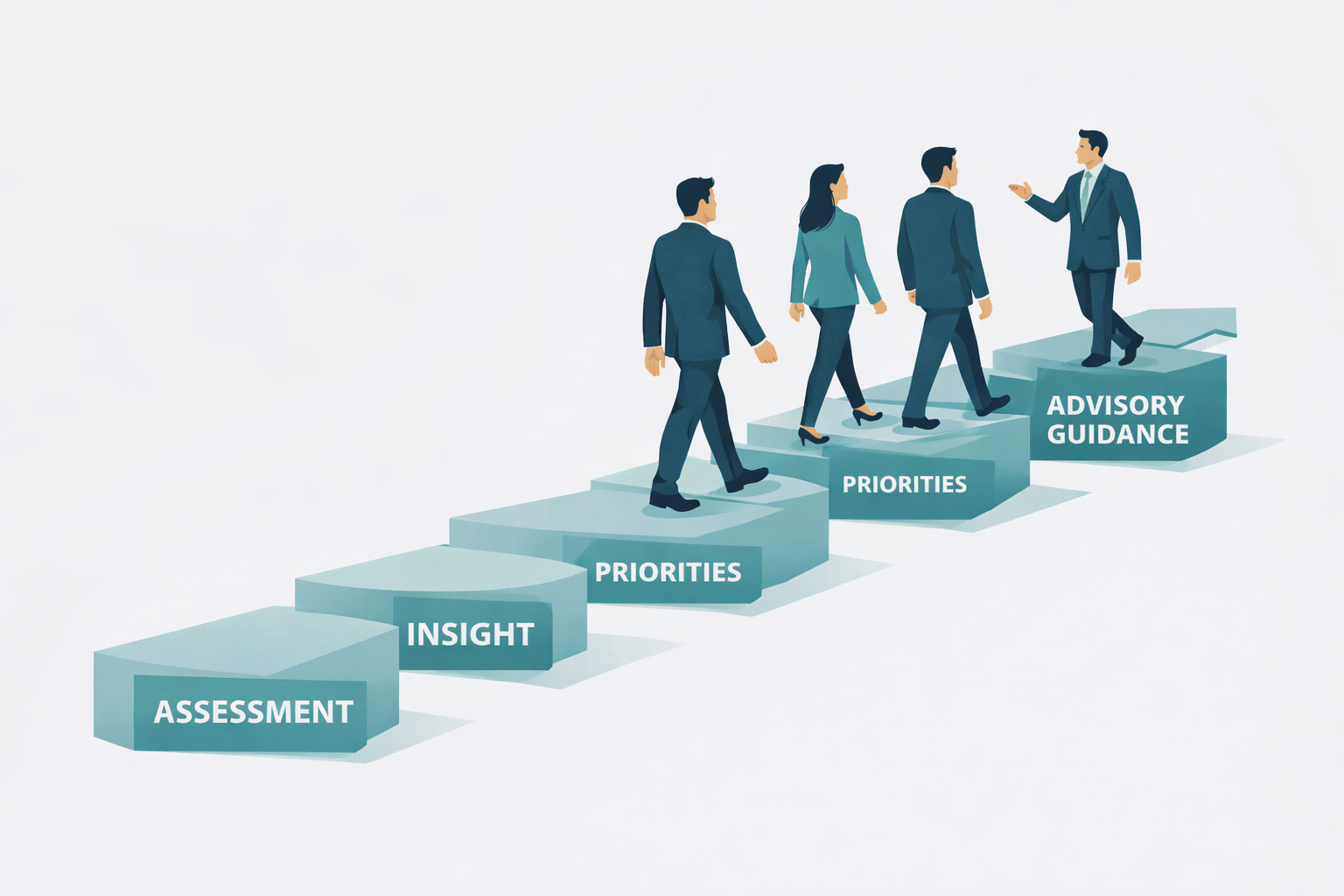
Advisory relationships are often misunderstood before they begin.
Most business owners have a general sense of what consulting looks like: a firm is engaged, a team conducts analysis, a report is delivered, recommendations are made. The engagement ends. Implementation — if it happens at all — is left to the organization.
Corvata is built differently. Not because the deliverables-first model is without merit in every context, but because it does not produce what matters most: durable improvement in how the enterprise actually operates.
Understanding how Corvata works requires understanding why the sequence matters. Assessment before advisory. Diagnosis before prioritization. Structural clarity before implementation. Each phase builds on the one before it, and the accumulation of that work over time is what produces the institutional discipline that makes an enterprise genuinely transferable.
Why Structure Precedes Advice
The most common failure in advisory work is the absence of an honest diagnostic foundation.
Advisors who begin with recommendations are working from an incomplete picture of the enterprise. They may have strong instincts developed from prior engagements, relevant sector experience, and well-developed frameworks. But without a structured evaluation of how this specific enterprise actually functions — how decisions move, where authority is concentrated, and what the operating disciplines look like across the ten enterprise domains — recommendations are educated guesses layered on an unexamined foundation.
The result is advisory work that addresses surface symptoms without identifying structural causes. Problems recur. Improvements do not hold. The organization experiences the appearance of progress without the substance of it.
Corvata addresses this by making assessment the explicit starting point of every engagement. Not assessment as a formality before the real work begins, but assessment as the work that makes everything else meaningful.
You cannot strengthen what you have not seen clearly. Assessment is the act of seeing the enterprise clearly — often for the first time.
Phase One: The Corvata Enterprise Readiness Assessment™
Every Corvata engagement begins with the Enterprise Readiness Assessment — a structured evaluation of the organization’s operating maturity across all ten enterprise domains and six operating disciplines defined in the Enterprise Readiness Operating Model™.
The assessment is not a compliance review. It does not ask whether the right documents exist or whether the org chart has been updated recently. It examines how the enterprise actually functions: how work moves, how authority is exercised, how decisions translate into execution, and whether the operating conditions that determine institutional strength are present or absent.
The assessment draws on multiple forms of evidence.
- Leadership narratives about how decisions are made and where authority sits
- Operational documentation and the degree to which it reflects current practice
- Governance structures and whether they function consistently or exist primarily on paper
- Decision and communication patterns across the leadership team
- Execution follow-through on past commitments and strategic initiatives
- Patterns of escalation that reveal where clarity about authority breaks down
The output is not a score. It is a readiness profile — a structured interpretation of the enterprise that identifies institutional strengths, structural vulnerabilities, decision bottlenecks, and the degree of founder dependence embedded in the operating model.
That profile creates the diagnostic foundation for everything that follows. It also creates something equally important: a shared language between the leadership team and the advisor for discussing the enterprise honestly.
Phase Two: Diagnostic Interpretation
Assessment data does not interpret itself. The second phase of the engagement focuses on understanding what the assessment reveals about the underlying structure of the enterprise — not as a list of isolated findings, but as a coherent picture of the operating conditions that shape organizational behavior.
This is where patterns become visible that were not apparent from inside the organization. Several domains may exhibit inconsistent execution — which often reflects unclear decision rights rather than poor follow-through. Documentation may be strong in some functions and absent in others — which frequently indicates that institutional memory is concentrated in specific individuals rather than distributed across the enterprise. Governance structures may exist without producing the accountability they were designed to create — which suggests the disciplines required to make structure functional have not been embedded.
Diagnostic interpretation helps leadership distinguish between operational noise and structural weakness. Not every problem requires structural change. The advisory process focuses on identifying the conditions that materially influence enterprise durability — and separating them from the surface friction that resolves itself through normal management attention.
By the end of this phase, leadership has a significantly clearer view of how their enterprise operates and why it produces the patterns it produces. That clarity is often described as the most valuable single outcome of the early engagement.
Phase Three: Priority Architecture
Most organizations uncover more potential improvement opportunities through assessment than they can realistically address at once. Attempting to correct every weakness simultaneously overwhelms the organization and produces scattered activity without meaningful progress.
The priority architecture phase identifies the few structural improvements that will produce the greatest strengthening of the enterprise — and sequences them in a way that allows the organization to build momentum rather than accumulate initiative fatigue.
Priorities are selected collaboratively. The advisor brings structural insight and an objective view of where risk is concentrated. The leadership team brings knowledge of organizational capacity, strategic direction, and risk tolerance. Together they define an improvement agenda that is ambitious enough to matter and focused enough to execute.
The priorities that typically emerge from this phase involve:
- Clarifying decision rights across leadership roles so authority is understood rather than assumed
- Establishing documentation practices that preserve institutional memory for material decisions
- Strengthening governance cadence so critical conversations happen consistently rather than intermittently
- Improving accountability structures so execution ownership is visible and held
- Reducing founder dependence in specific operational areas where concentration of authority creates fragility
The output of this phase is not a project plan. It is an architectural improvement agenda — a clear map of the structural work that will move the enterprise toward greater institutional strength.
Phase Four: Advisory Engagement
Implementation guidance is where the advisory relationship takes its most sustained form. Corvata advisors work alongside leadership teams through structured, recurring advisory sessions — typically weekly or biweekly — that create a disciplined operating rhythm for examining the enterprise and guiding structural improvement.
The structure of these sessions is deliberate. They are not operational check-ins or project status reviews. They are forums for disciplined examination of how the enterprise is functioning, how decisions are moving, and where the structural improvements identified during priority architecture are taking hold or encountering resistance.
During advisory sessions, the advisor helps leadership:
- Examine significant decisions through the lens of the Decision Discipline Framework™ — ensuring that issues are framed clearly, ownership is assigned, and commitment occurs rather than accumulates
- Identify patterns in how the organization is responding to structural change — where new disciplines are embedding and where older habits are reasserting themselves
- Address the governance and authority questions that arise as the enterprise begins operating differently
- Maintain focus on the structural priorities identified during the prior phase rather than drifting toward immediate operational concerns
The advisor’s role in this phase is not to manage the organization or make decisions on behalf of leadership. It is to provide the structure, perspective, and disciplined questioning that helps leadership think more clearly about the enterprise they are building.
Durable organizations develop internal judgment rather than relying indefinitely on external expertise. The advisory relationship is designed to strengthen leadership capability — not substitute for it.
Phase Five: Enterprise Stabilization
Structural improvements require reinforcement before they become embedded. Without it, organizations that have made genuine progress during the implementation phase often find that operational pressure gradually reasserts older habits. The work done during the engagement begins to erode.
The stabilization phase shifts advisory focus toward ensuring that the improvements introduced earlier in the engagement become durable components of the enterprise’s operating architecture rather than temporary interventions.
This may involve reinforcing documentation practices that have begun to slip, reviewing the effectiveness of new decision rights structures as the organization tests them under real conditions, refining communication protocols based on what has worked and what has not, and identifying areas where the enterprise may be reverting to previous patterns under pressure.
Stabilization is not remediation. It is the final phase of embedding — the work of ensuring that what has been built holds.
What the Engagement Produces
The output of a full Corvata engagement is not a report, a recommendation, or a set of deliverables. It is a measurably more durable enterprise.
Leadership teams that complete the engagement consistently describe similar shifts. Decision discussions become cleaner. Authority distributes more naturally. Execution follows commitment more reliably. The founder finds herself less frequently drawn into decisions that the organization should be capable of resolving without her.
These shifts do not happen because the advisor told the organization what to do. They happen because the leadership team developed a clearer view of how the enterprise functions, identified the structural conditions that most needed to change, and did the sustained work of changing them.
The advisory relationship is temporary. The enterprise conditions it produces are not. That distinction is the point of the entire engagement.
The engagement begins with clarity.
If you lead a government contracting firm and want to understand how your enterprise actually operates — where institutional strength exists, where structural risk is concentrated, and what it would take to build something genuinely transferable — the Corvata Enterprise Readiness Assessment™ is where that work begins.