
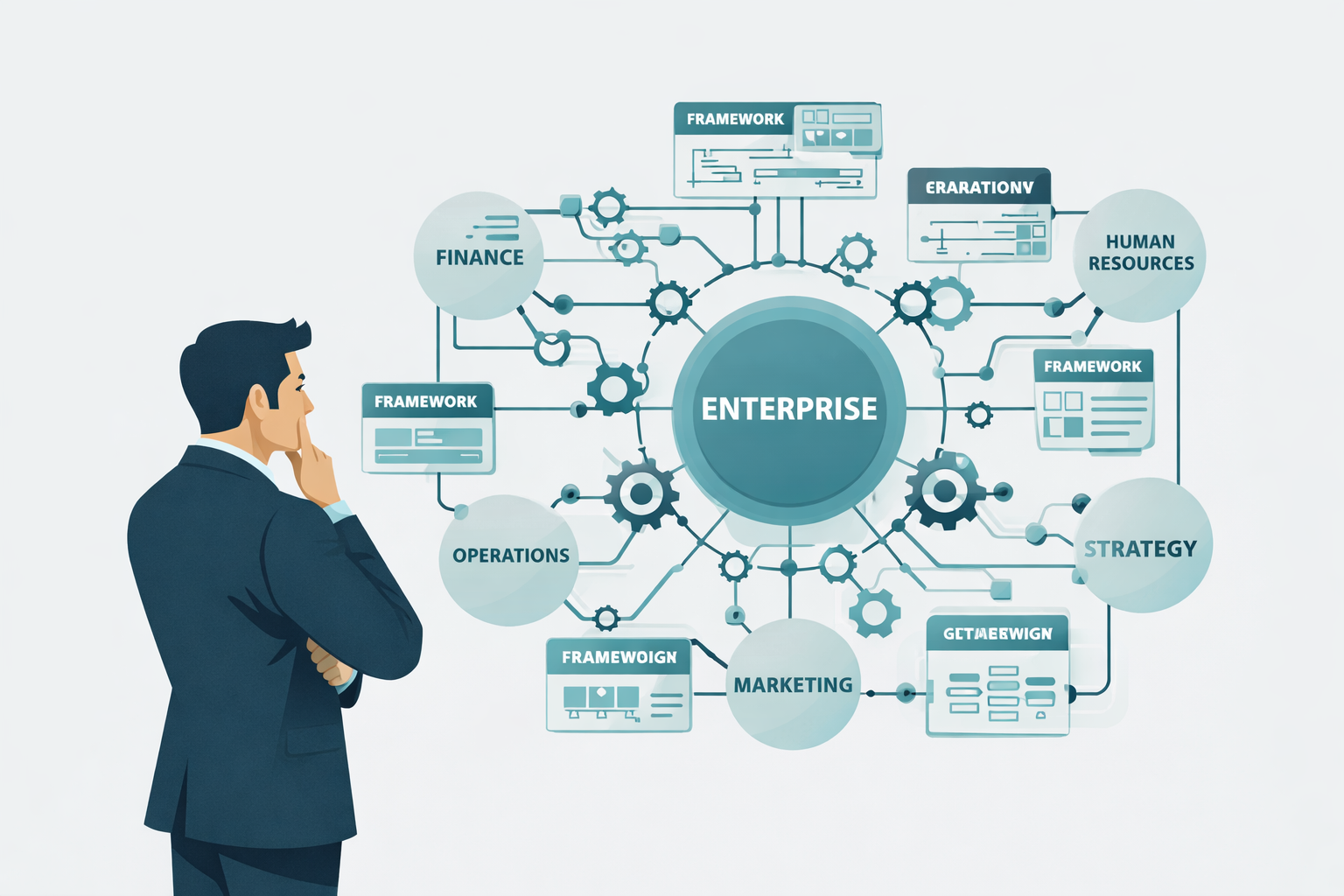
Enterprise readiness is not an abstract aspiration. It is a structural condition — one that either exists inside an organization or it does not. And like most structural conditions, it can be examined, measured, and systematically strengthened.
That is what the Enterprise Readiness Operating Model is designed to do.
The EROM is the governing architecture behind Corvata’s advisory work. It provides a coherent framework for understanding how an enterprise functions — where value lives, how it is stabilized, and whether judgment moves through the organization with the discipline required for long-term durability.
Understanding the model requires understanding its three integrated components.
The Problem the Model Addresses
Most organizations are not designed. They evolve.
Processes emerge through habit and repetition. Authority concentrates around individuals who demonstrate competence. Decisions travel through informal channels rather than visible structures. Governance practices appear when external pressure demands them and recede when it does not.
From inside the organization, these patterns feel natural. They represent how the business has always operated. As long as performance remains strong, few leaders feel compelled to examine the underlying operating architecture.
But when the enterprise is examined from the perspective of durability — whether it can scale, sustain leadership transition, withstand disruption, or support a strategic transaction — a different picture often emerges. The business may perform well while still relying heavily on informal structures, personality-driven authority, and undocumented institutional knowledge.
These conditions do not prevent success in the present. They limit what becomes possible in the future.
The Enterprise Readiness Operating Model exists to make these conditions visible — and to provide a systematic architecture for strengthening them.
Component One: Enterprise Structure
The first component of the EROM is Enterprise Structure. It answers a deceptively simple question: where does value live in this organization?
Corvata identifies ten Enterprise Domains — the functional areas where value is created, protected, and transferred. These are not departments or org chart categories. They are the core institutional systems through which the enterprise operates.
- Governance
- People
- Operations
- Finance
- Technology
- Risk
- Compliance
- Contracts
- Capital Strategy
- Growth
Each domain represents a cluster of recurring decisions, responsibilities, and processes. Enterprise value does not exist in the abstract. It exists inside the integrity and maturity of these domains.
A business may be profitable while several domains remain underdeveloped. That underdevelopment may be invisible during normal operations. It becomes visible — and consequential — when the enterprise is examined under scrutiny: by a buyer, an investor, a successor, or a leadership team honest enough to look.
Buyers discount valuation when domains are weak. Succession plans fail when domains are fragile. Growth stalls when domains cannot absorb complexity. The ten enterprise domains are not a framework for compliance. They are the map of where enterprise value actually resides.
Component Two: Enterprise Discipline
Structure alone is insufficient. Domains must operate with discipline.
This is the second component of the EROM: Enterprise Discipline. It answers the question that structure cannot: whether the value within these domains is being stabilized or is personality-dependent.
Corvata defines the six Exit Ready Disciplines that stabilize enterprise maturity across every domain.
- Policies — Defined decision rights and operating standards that clarify how work should occur
- Cadence — Structured rhythms for review, oversight, and accountability that ensure critical conversations happen consistently
- Accountability — Clear ownership of outcomes, decisions, and execution at every level of the organization
- Evidence — Documentation that decisions and actions have occurred, preserving institutional memory across leadership transitions
- Currency — Ongoing relevance and adaptation, ensuring processes and documentation remain current rather than obsolete
- Execution — Consistent implementation that converts commitment into action
These six disciplines transform informal leadership behavior into institutionalized operating standards. Without them, even well-designed domain structures drift toward personality dependence. With them, domains mature into durable institutional systems.
Consider what discipline looks like in practice. Policies clarify who decides. Cadence ensures decisions surface regularly rather than accumulating until they become crises. Accountability ensures someone owns the outcome and cannot quietly step away. Evidence preserves the organizational reasoning that disappears when people leave. Currency prevents stagnation. Execution converts intent into the work that actually moves the enterprise forward.
Structure defines where value lives. Discipline determines whether that value is stable or fragile.
Component Three: Enterprise Decision Flow
The third component of the EROM governs how the enterprise moves. If Structure defines where value lives and Discipline stabilizes it, Decision Flow is what powers the entire system.
Every enterprise runs on decisions. Every domain is, at its core, a system of recurring decisions — who has authority, what information is required, how commitment occurs, how execution is held accountable, and how outcomes are reviewed.
The Decision Discipline Framework™ defines the six-stage flow that governs how decisions move through the organization: Trigger, Frame, Sufficiency, Commitment, Communicate, and Execute and Monitor.
When this flow works, decisions emerge clearly, move efficiently, and produce sustained execution. When it breaks down, the organization experiences friction that leadership often mislabels as a communication problem, a culture problem, or a people problem. In most cases, it is a decision system problem.
The EROM also identifies the seven Decision Failure Modes™ — the predictable patterns through which decision systems deteriorate: decision avoidance, decision delay, over-analysis, undocumented commitments, opaque decisions, unexecuted initiatives, and decision reversal. These are not personality flaws. They are operating system failures, and they appear in recognizable patterns across organizations of all sizes and sectors.
How the Three Components Work Together
The power of the Enterprise Readiness Operating Model is not in any single component. It is in how the three components integrate.
Enterprise Structure defines the domains where value resides. Enterprise Discipline stabilizes those domains through consistent operating practices. Enterprise Decision Flow ensures that judgment moves through the enterprise with clarity, ownership, and accountability.
Remove any one of these components and the system weakens. Strong domains without discipline drift toward personality dependence. Strong discipline without decision flow produces structure that cannot move. Strong decision flow without structural clarity produces motion without direction.
Together, they create something the EROM calls institutionalized judgment — the condition in which an organization’s capacity to make and execute decisions is embedded in the enterprise itself rather than concentrated in specific individuals.
Institutionalized judgment is what buyers underwrite. It is what successors inherit. It is what allows an enterprise to function, scale, and transfer with reliability.
The Model in Advisory Practice
The EROM is not a theoretical construct. It is the operating lens through which Corvata examines every client engagement.
The Corvata Enterprise Readiness Assessment™ evaluates maturity across all ten enterprise domains and across each of the six operating disciplines, producing a readiness profile that reveals how the enterprise actually functions. Not how leadership assumes it functions, and not how it would be presented to an external audience, but the operating reality that governs daily performance.
That profile becomes the foundation for advisory work. It identifies where structural improvement will have the greatest impact, where institutional strength already exists, and where decision flow is creating friction that compounds over time.
The goal is not to produce a compliant organization. The goal is to produce a durable one — one that operates with the institutional clarity required to sustain value across leadership transitions, strategic growth, and whatever the future demands of it.
Enterprise readiness can be strengthened systematically. The Enterprise Readiness Operating Model is the architecture that makes that possible.
See how your enterprise measures up.
The Corvata Enterprise Readiness Assessment evaluates your organization across all ten enterprise domains and six operating disciplines — producing a readiness profile that reveals where institutional strength exists, where value is at risk, and where targeted improvement will have the greatest impact on enterprise durability.