
How Enterprise Maturity Is Stabilized
Structure alone is insufficient.
An organization can define roles, processes, and domains — and still erode over time.
Enterprise durability requires discipline.
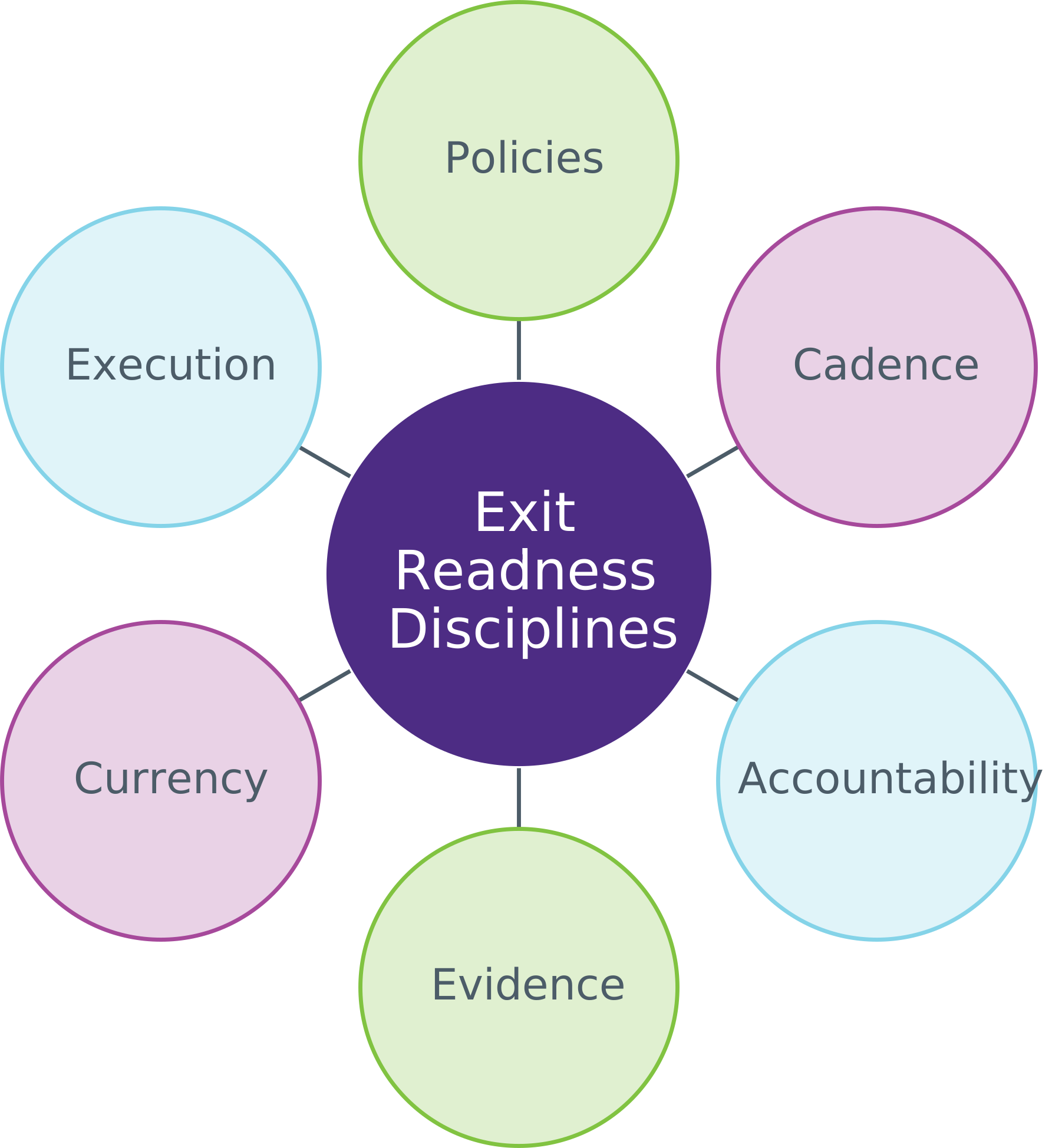
The six Exit Ready Disciplines convert informal leadership behavior into institutional operating standards. They prevent value from becoming personality-dependent.
Across all ten Enterprise Domains, these disciplines determine whether maturity is stabilized — or drifting.
They answer a fundamental question:
Is value institutionalized, or does it depend on a few individuals?
1. Policies
Defined Decision Rights and Standards
Policies establish clarity.
They define:
- Who decides
- What authority they hold
- What standards govern action
- What thresholds trigger escalation
Without defined decision rights, organizations experience:
- Decision confusion
- Informal power structures
- Inconsistent outcomes
Mature enterprises define authority explicitly.
Buyers assess whether decision rights are structured or implied.
Policies create boundaries for judgment.
2. Cadence
Structured Rhythms for Review and Oversight
Cadence creates rhythm.
It determines:
- How often decisions are reviewed
- Where performance is examined
- When strategic recalibration occurs
- How accountability is surfaced
Without cadence, issues remain latent until they become crises.
Mature enterprises embed structured review cycles across finance, operations, growth, risk, and governance.
Cadence prevents drift.
It forces visibility.
3. Accountability
Clear Ownership of Outcomes
Accountability assigns ownership.
It ensures:
- Decisions have named owners
- Outcomes are measured
- Responsibilities are not diffuse
- Escalation is defined
Without accountability:
- Decisions stall
- Blame circulates
- Execution weakens
Durable enterprises tie authority to responsibility.
Buyers evaluate whether ownership is clear — or ambiguous.
4. Evidence
Documented Decisions and Traceable History
Evidence institutionalizes memory.
It preserves:
- Decision rationale
- Approval records
- Contract history
- Policy evolution
- Outcome review
Undocumented decisions increase risk.
They weaken due diligence.
They create transfer friction.
Mature enterprises create traceability.
Buyers underwrite documented judgment — not verbal assurances.
5. Currency
Ongoing Relevance and Adaptation
Currency prevents stagnation.
It ensures:
- Policies are reviewed
- Processes evolve
- Technology remains aligned
- Risk profiles are updated
- Governance adapts to growth
Organizations decay when frameworks remain static while complexity increases.
Mature enterprises institutionalize review and renewal.
Currency sustains relevance.
6. Execution
Consistent Implementation
Execution converts intent into action.
It determines whether:
- Decisions are implemented
- Commitments are fulfilled
- Initiatives are completed
- Outcomes are monitored
Without execution, structure becomes theoretical.
Execution transforms planning into enterprise durability.
Buyers assess whether strategy translates into operational reality.
HOW THE DISCIPLINES INTERACT
The disciplines are not independent controls.
They operate as a stabilizing system:
- Policies clarify authority.
- Cadence surfaces decisions.
- Accountability assigns ownership.
- Evidence preserves integrity.
- Currency maintains relevance.
- Execution delivers outcomes.
Remove any one discipline, and the system weakens.
Together, they convert leadership behavior into institutional architecture.
DISCIPLINE AS A VALUATION DRIVER
When discipline is embedded:
- Decision consistency improves
- Transfer risk declines
- Leadership transition friction reduces
- Audit and due diligence accelerate
- Valuation risk compresses
Without discipline, even strong domains erode.
Exit readiness is not about preparing documents.
It is about stabilizing maturity.
Stability Is Measured — Not Assumed
The Corvata Enterprise Readiness Assessment™ evaluates how effectively the six Exit Ready Disciplines
are embedded across your enterprise.