
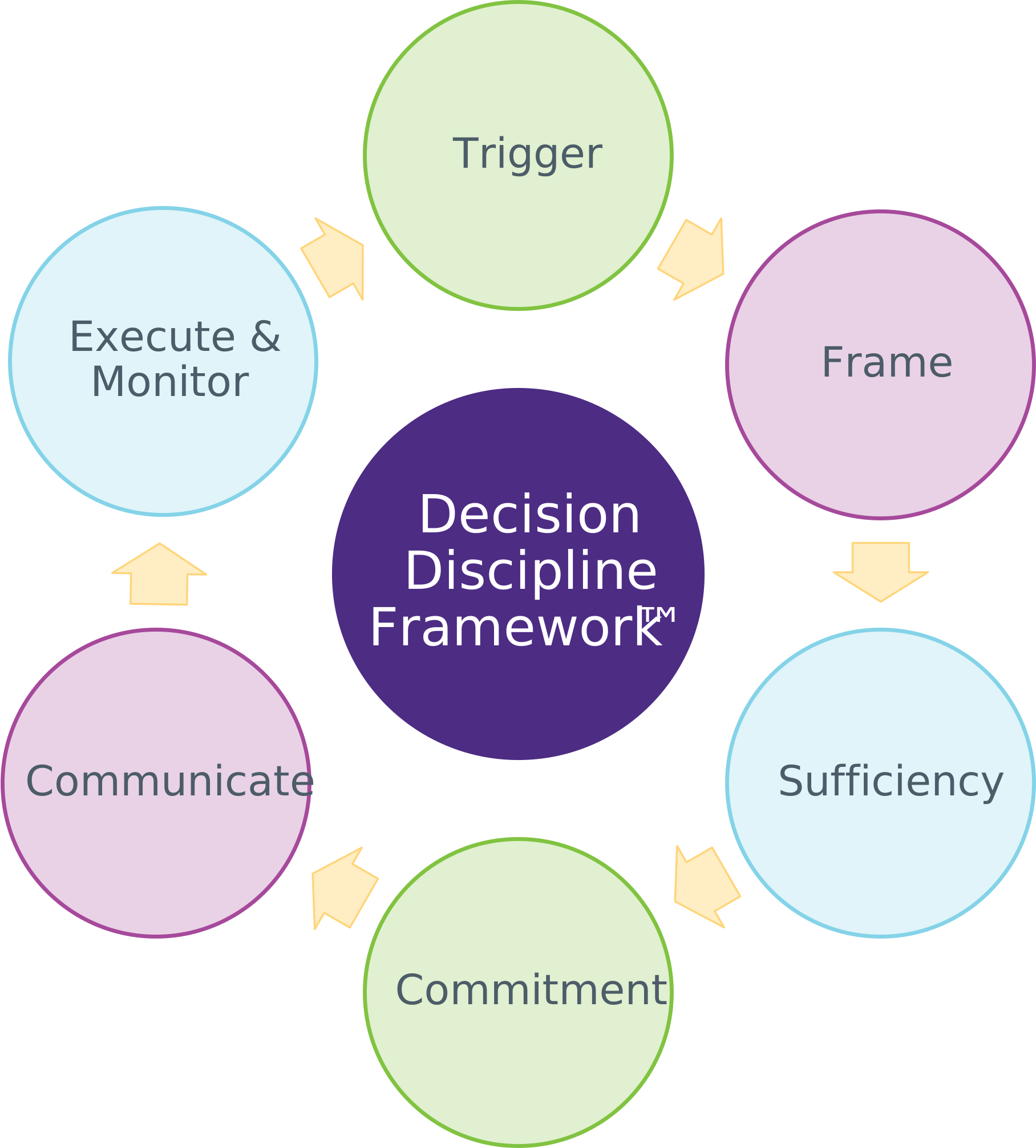
How Judgment Moves Through an Enterprise
Every enterprise runs on decisions.
Strategy is a collection of decisions.
Operations are a stream of decisions.
Governance exists to structure decisions.
When decisions stall, drift, or fragment, enterprise value erodes.
The Decision Discipline Framework defines the six-stage flow that governs how decisions move through an organization.
It is not about speed alone.
It is about clarity, sufficiency, commitment, and execution.
The question this framework answers:
Does judgment move cleanly through the enterprise — or does it break down under complexity?
The Six-Stage Decision Flow
1. Trigger
An Issue or Opportunity Surfaces
Every decision begins with a trigger.
A trigger may be:
- A performance variance
- A regulatory change
- A client issue
- A strategic opportunity
- A risk exposure
Mature enterprises ensure triggers are visible — not buried.
Without defined trigger recognition, issues escalate before leadership responds.
2. Frame
The Decision Is Clearly Defined and Owned
Framing clarifies:
- What exactly is being decided
- Who owns the decision
- What constraints apply
- What success looks like
Poor framing leads to:
- Endless discussion
- Misaligned assumptions
- Unclear authority
Clarity at this stage prevents confusion later.
3. Sufficiency
Enough Information — Not Perfection
Sufficiency balances rigor and velocity.
It asks:
- What information is required?
- What level of analysis is appropriate?
- What risk tolerance applies?
Immature systems either:
- Rush decisions without clarity
- Or delay decisions seeking perfection
Disciplined enterprises gather enough information to decide — not enough to avoid deciding.
4. Commitment
The Decision Is Formally Made
Commitment marks the transition from analysis to action.
It requires:
- Clear approval
- Defined authority
- Documented outcome
Undocumented commitments create ambiguity.
Mature enterprises record decisions in a way that survives personnel change.
5. Communicate
Stakeholders Are Aligned
Communication ensures:
- Affected parties understand the decision
- Expectations are clear
- Direction is not inferred
Breakdowns here lead to:
- Conflicting execution
- Passive resistance
- Misaligned interpretation
Alignment reduces friction.
6. Execute & Monitor
Implementation and Outcome Review
Execution converts commitment into reality.
Monitoring evaluates:
- Was the decision implemented?
- Did it produce intended results?
- What adjustments are required?
Many organizations decide well — and execute poorly.
Enterprise durability requires closing the loop.
Where Decision Flow Breaks
When value erodes, it is rarely because people lack intelligence.
It is because the flow breaks.
Common breakdowns include:
- Avoided decisions
- Delayed decisions
- Over-analysis
- Undocumented commitments
- Uncommunicated direction
- Unexecuted initiatives
- Reversal without clarity
These are not personality flaws.
They are operating system failures.
Decision Flow as a Durability Signal
Buyers and sophisticated partners evaluate decision integrity.
They look for:
- Documented approvals
- Defined authority thresholds
- Consistent execution
- Institutional memory
- Outcome review discipline
They assess whether the enterprise can continue functioning when key individuals exit.
When decision flow is structured:
- Velocity improves
- Friction declines
- Authority distributes
- Risk compresses
- Transition becomes cleaner
Decision discipline is not administrative overhead.
It is structural stability.
Connection to The Corvata Enterprise Readiness Assessment™
Within the Enterprise Readiness Assessment, each domain is evaluated not only for structural maturity — but also for decision maturity.
The Decision Discipline Framework™ informs measurement of:
- Decision clarity
- Decision velocity
- Documentation integrity
- Communication alignment
- Execution consistency
- Review discipline
The result is a measurable profile — not a subjective impression.
Does Decision Integrity Exist in Your Enterprise?
The Corvata Enterprise Readiness Assessment™ evaluates how effectively decisions move
through your organization — across every domain.