Exit readiness is a discipline, not a transaction.

The Enterprise Domains

Where Enterprise Value Lives

Enterprise value does not exist in the abstract.

It exists inside operating domains — clusters of recurring decisions, responsibilities, systems, and controls.

A business may generate revenue while several domains remain underdeveloped. But when evaluated through a buyer’s lens, weaknesses across domains surface quickly as:

  • Valuation discounts
  • Deal friction
  • Transfer risk
  • Founder dependence

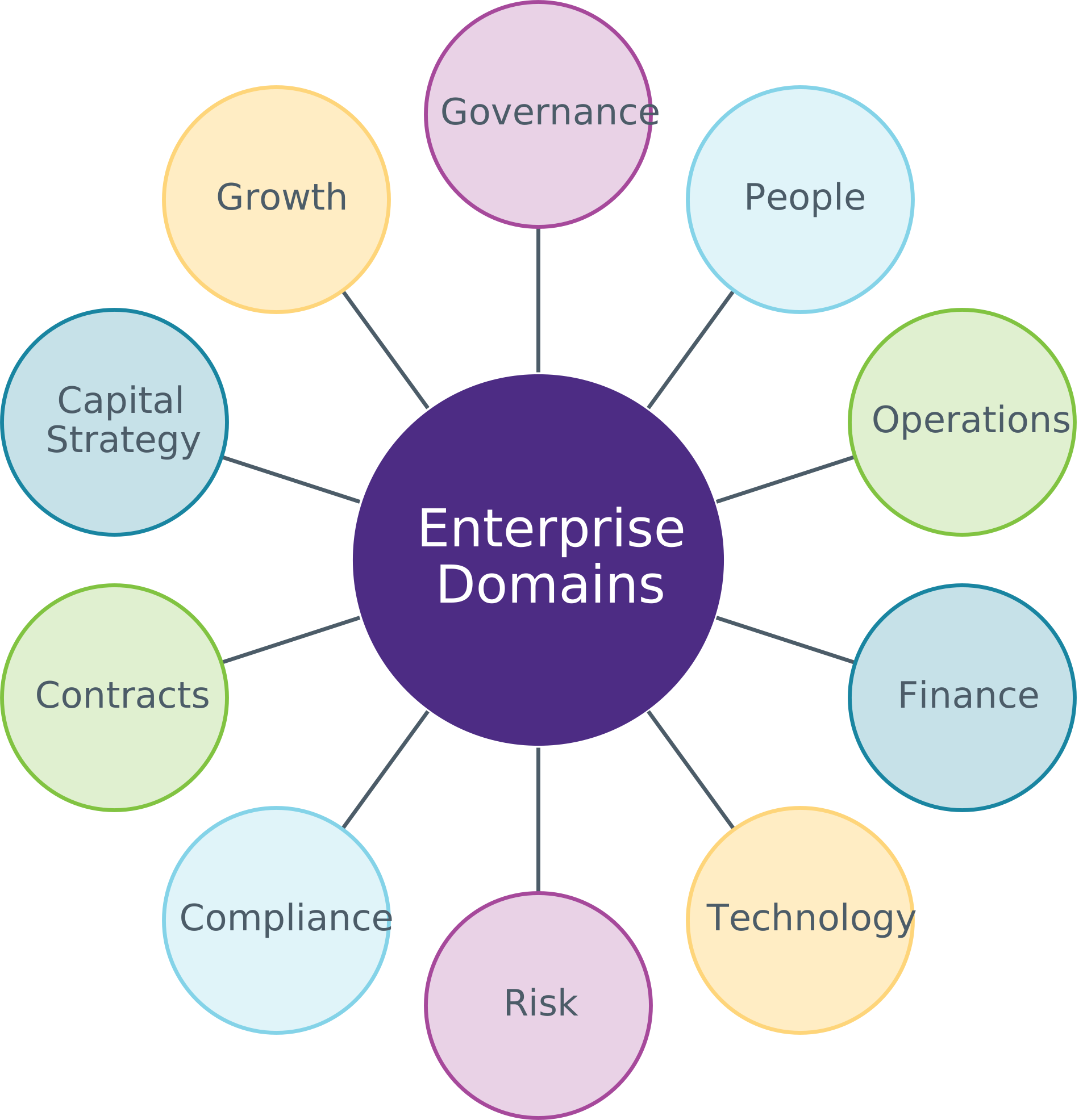
The ten Enterprise Domains define the functional architecture of a durable enterprise.

Together, they answer a foundational question:

Where does value live in this organization?

1. Finance

Finance reflects the economic integrity of the enterprise.

This domain includes:

  • Financial reporting accuracy
  • Cash flow predictability
  • Margin visibility
  • Cost structure clarity
  • Forecasting discipline
  • Capital allocation decisions

Immature finance functions obscure performance.
Mature finance functions illuminate it.

Buyers evaluate whether financial information is reliable, timely, and decision-supportive — not merely compliant.

Durable enterprises use finance as an operating instrument, not a historical record.

2. Governance

Governance defines how authority is structured and oversight is exercised.

This domain includes:

  • Decision rights clarity
  • Leadership structure
  • Board or advisory oversight
  • Policy framework
  • Escalation protocols
  • Ownership alignment

Weak governance concentrates authority in individuals.

Strong governance distributes authority within a defined structure.

Buyers assess whether decisions are institutionalized or personality-driven.

Governance determines whether the enterprise can survive leadership transition.

3. People

People represent the capability layer of the organization.

This domain includes:

  • Role clarity
  • Talent development
  • Succession planning
  • Incentive alignment
  • Cultural coherence
  • Leadership bench strength

An enterprise dependent on a few key individuals carries transfer risk.

A durable enterprise develops distributed capability and defined accountability.

Buyers evaluate whether institutional knowledge is embedded or concentrated.

4. Operations

Operations define how work gets executed.

This domain includes:

  • Process standardization
  • Performance metrics
  • Capacity planning
  • Delivery consistency
  • Quality controls
  • Operational documentation

Operational maturity reduces friction and variability.

Buyers examine whether performance is repeatable — not heroic.

Strong operations convert strategy into consistent output.

5. Growth

Growth reflects the enterprise’s forward momentum.

This domain includes:

  • Business development systems
  • Market positioning
  • Customer concentration risk
  • Pipeline visibility
  • Revenue diversification
  • Strategic planning discipline

Reactive growth creates volatility.

Disciplined growth builds predictability.

Buyers assess whether revenue expansion is system-driven or relationship-dependent.

6. Compliance

Compliance protects the enterprise from regulatory and contractual risk.

This domain includes:

  • Regulatory adherence
  • Contract compliance
  • Internal controls
  • Risk mitigation processes
  • Audit readiness
  • Documentation integrity

Compliance maturity reduces uncertainty.

Buyers evaluate exposure — not intent.

Durable enterprises integrate compliance into daily operations rather than treating it as episodic remediation.

7. Technology

Technology enables scalability and information integrity.

This domain includes:

  • System integration
  • Data reliability
  • Cybersecurity posture
  • Process automation
  • Reporting infrastructure
  • Platform scalability

Technology fragmentation creates friction and blind spots.

Integrated systems enable clean information flow and scalable growth.

Buyers assess whether systems support decision-making or obscure it.

8. Contracts

Contracts define how obligations are structured and risk is allocated.

This domain includes:

  • Contract lifecycle management
  • Terms standardization
  • Change order discipline
  • Revenue recognition alignment
  • Documentation controls
  • Portfolio analysis

Undisciplined contract management introduces revenue and legal risk.

Mature contract governance strengthens predictability and enforceability.

Buyers examine contractual durability and exposure.

9. Capital Strategy

Capital Strategy governs how the enterprise is financed and positioned for liquidity.

This domain includes:

  • Capital structure clarity
  • Debt management
  • Equity alignment
  • Distribution policy
  • Investment planning
  • Exit optionality

Misaligned capital decisions constrain future flexibility.

Strategic capital allocation enhances enterprise value.

Buyers evaluate financial leverage, shareholder alignment, and structural readiness.

10. Risk

Risk represents the enterprise’s exposure profile.

This domain includes:

  • Enterprise risk management
  • Insurance adequacy
  • Dependency analysis
  • Scenario planning
  • Continuity planning
  • Concentration exposure

Risk does not eliminate value.
Unmanaged risk discounts it.

Buyers assess the probability of disruption — not optimism.

Durable enterprises proactively identify and mitigate systemic vulnerabilities.

HOW THE DOMAINS WORK TOGETHER

No single domain defines enterprise value.

Weakness in one domain can erode strength in another.

Strong finance cannot compensate for weak governance.
Strong operations cannot offset concentrated growth risk.
Strong compliance cannot overcome fragile leadership.

Enterprise durability emerges when all domains mature in parallel.

This is why the Enterprise Readiness Assessment evaluates all ten domains — not selectively.